This article explains what back translation is, its purpose, methods, and examples of its use.
First, we explain manual back translation incorporated into the translation process. In the second half, we introduce, with concrete examples, how business professionals who regularly work with foreign languages can use machine translation for back translation.
High-quality translation for text and files
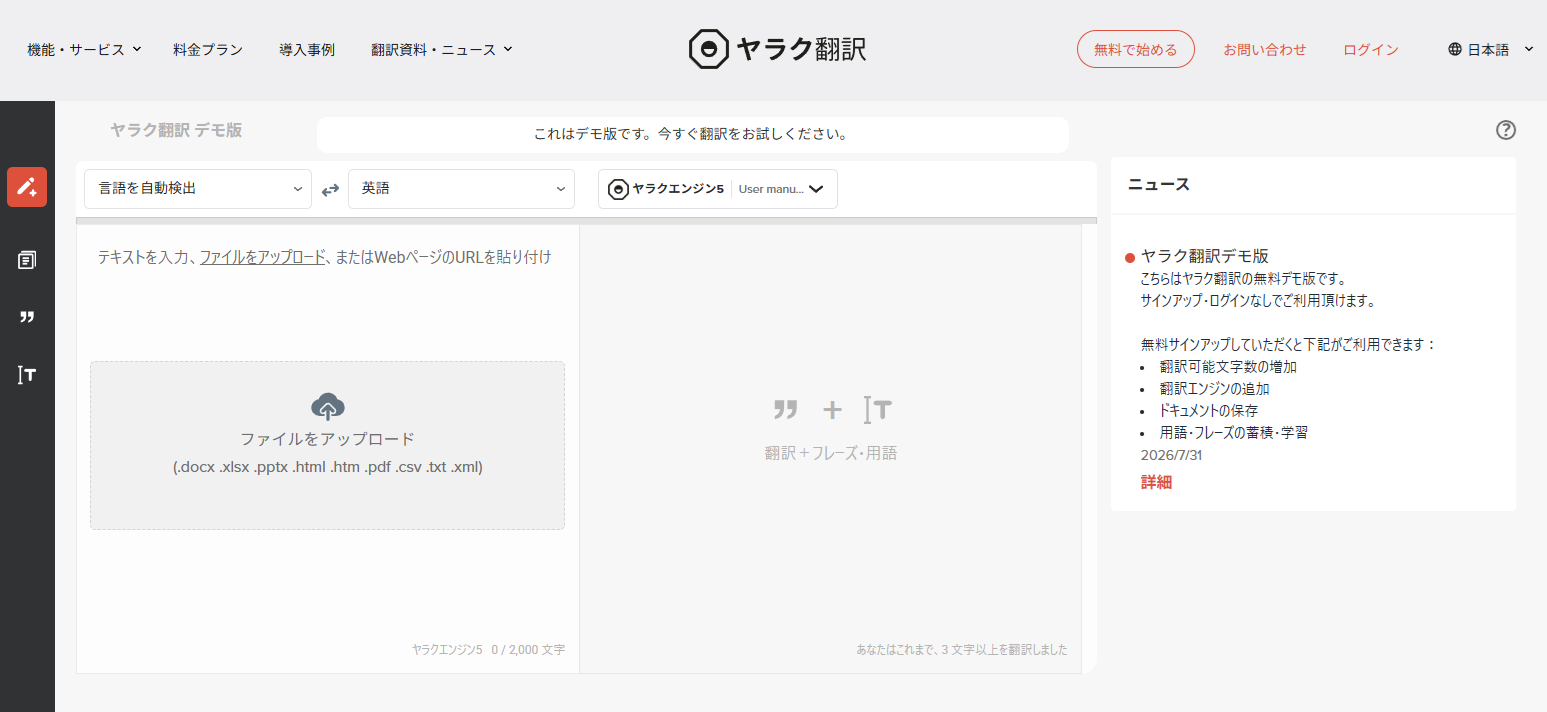
Try the free Yaraku Translate demo with no sign-up required. Enter text or upload a file to get your translation. Give it a try.

Expert review: Masaru Yamada
He is a professor at Rikkyo University College/Graduate School of Intercultural Communication. After working as an in-house interpreter at Ford Motor Company and as an industrial translator, he founded Translation Lab Inc. He also serves as Chief Evangelist at Yaraku, Inc. (Full profile)
This article was localized from an expert-reviewed Japanese manuscript.
Conclusion
Back-translation is a technique that involves translating a text back into its original language and comparing it to the original to identify discrepancies in meaning or areas that need clarification. For documents where accuracy is particularly important, manual back translation should be considered, while for daily operations, incorporating back translation using machine translation can provide clues for reviewing the translation.
Summary of this article
- What is back translation, its purpose, suitable documents, and examples?
- How to incorporate back translation into your daily translation work (Yaraku Translate’s “back translation” function)
- Comparison of the advantages and disadvantages of back translation using machine translation versus manual back translation.
What is “back translation”?
What comes to mind when you hear the term “back translation”?
You might see the term “back translation” on social media, but in translation work, it refers to a method used to verify the translated text.
In translation work, “back translation” refers to translating a text back into its original language without referring to the original source text. For example, in Japanese-English translation, a text translated from Japanese to English is then translated back into Japanese from English without referring to the original Japanese text.
The purpose of back translation and the types of documents it is suitable for.
Back-translation is one method for verifying the content of a translated text. It is often used in fields such as medicine, pharmacy, and patents, where there is a lot of specialized terminology and it is important to accurately reflect the information in the original text. For documents where mistranslation can have a significant impact, it is important to implement multiple verification processes, including back translation, to verify the content of both the original and translated texts.
* “Accuracy” refers to whether the information in the source text is correctly reflected in the translation. (Reference: Translation Quality Evaluation Process in Practical Translation)
On the other hand, there are documents for which back translation is not always suitable. In documents where accuracy, naturalness of expression, and creativity are important, such as literature, games, plays, poetry, advertisements, and speeches, the structure of the original and translated text can differ significantly due to paraphrasing and adjustments to expression. Therefore, it can be difficult to judge the quality of a translation solely based on the results of back translation.
Examples of back translation
Now, let’s look at a concrete example to see how back translation can help identify differences in the translated text. Here, we’ll use a sentence from the user guide of the translation platform “Yaraku Translate” and explain the back translation process using Spanish as an example.
| Original text |
| Since machine translation sometimes fails to accurately translate proper nouns such as names of people and companies, registering terms helps reduce mistranslations and inconsistencies in spelling. |
Let’s assume the following is the sentence translated into Spanish by our staff:
| Translation |
| Las traducciones automáticas suelen cometer errores en nombres propios, como nombres de personas y de empresas, por lo que el registro de términos evita malas traducciones y errores ortográficos. |
If you’re not familiar with Spanish, it would be difficult to judge whether this translation is accurate just by looking at it. Therefore, we’ll have someone other than the original translator re-translate it into Japanese without looking at the original text.
| Japanese text after back translation |
| Machine translation often produces errors with proper nouns such as names of people and companies, so registering terms beforehand can help avoid mistranslations and spelling mistakes. |
In the original text, a part that was described as a “variation in spelling” has become a “spelling mistake” in the back translation. Since variations in spelling and spelling mistakes have different meanings, this highlights areas in the original translation that need to be checked. Back translation helps to organize these differences between the original text and the back-translated text, providing clues for reviewing the original translation.
Try incorporating back translation into your daily translation work.
Back translation is sometimes used in highly specialized fields such as patents, medicine, and pharmacology. On the other hand, the method of translating the translated text back into the original language and comparing the results can be used not only in these fields but also in everyday work involving foreign languages. From here, we will introduce back translation methods and examples that are easy to implement in business settings.
Yaraku Translate’s “back translation” function
The translation platform “Yaraku Translate” offers a “back translation” function. Unlike back translation that is manually incorporated into the translation process, this method uses automatic translation to translate the translated text back into the original language.
Use the back translation function to consider the expression of the translated text.
As an example, let’s take a sentence from an interview article. The Japanese on the left is the original text, and the English on the right is the translation.

*This is an example using file translation.
At first glance, it seems that the meaning of the original text is reflected. Now, let’s click the back translation icon and see the result after translating it back into the original language.

When we examine the latter half of the Japanese sentence after the back translation, we can see the differences from the original sentence. The original sentence contains three pieces of information: “The company expands its activities daily,” “It is necessary to record and report these activities,” and “I am in charge of this sequence of events.” On the other hand, in the back-translated sentence, “recording and reporting” modifies “events,” making the relationship between the company recording and reporting its daily activities unclear. In this example, there seems to be room for revision in the part where “sequence of events” is modified by a that clause. Therefore, we will revise the part after the comma in the English translation.

“The company expands its activities on a daily basis, and must record and report them, and I am responsible for the flow of this process.” After the revision, the three pieces of information contained in the original Japanese text are now clearer.
Even if you use English regularly, it can be time-consuming to check subtle nuances amidst other work and time constraints. Yaraku Translate’s back translation function allows you to translate the translated text back into the original language, providing clues to check for differences. Try using it as an aid when reviewing your translations.
Comparison of back translation using machine translation versus human back translation.
In the first half, we introduced manual back translation, and in the second half, we introduced the advantages and disadvantages of back translation using machine translation.
Benefits of using machine translation for back translation
- There is no need to arrange for another translator.
- Easy to keep additional costs down
- This could lead to new insights into language learning.
Using machine translation can potentially reduce additional time and costs because it eliminates the need to hire another translator for back translation. Furthermore, the process of comparing the original text with the back-translated version yourself can be helpful for language learning, as it helps you notice differences in expression and nuance.
Depending on the translation service, the information you input may be used to improve the service. When handling documents containing confidential or personal information, do not judge solely on whether the service is free or paid; instead, check each service’s data usage policy and choose a service that meets your company’s security requirements.
Disadvantages of using machine translation for back translation
- It may lack accuracy.
- A certain level of language proficiency and knowledge of machine translation will be helpful in verifying the results.
The verification process and necessary checks differ between human translation and machine translation. When using machine translation for back translation, it is important not to judge the accuracy of the back-translated text alone, but to check any awkward parts by comparing them with the original text. Furthermore, evaluating the results requires a certain level of language knowledge to discern nuances and an understanding of the mistranslations and omissions that can occur in machine translation.
*Reference book: “The Complete Guide to Machine Translation: Super English Techniques to Complete Endless English Work in 5 Minutes (ENGLISH HACKER’S HANDBOOK)” Sansai Books
What is back translation?
Back-translation is a technique that involves translating a text back into its original language and comparing it to the original to identify any discrepancies in meaning or areas that need clarification. By organizing the differences between the original text and the back-translated text, it provides clues for reviewing the original translation.
Can anyone perform a back translation using machine translation?
While machine translation can be used for back translation, a certain level of language proficiency to discern nuances and an understanding of potential mistranslations and omissions in machine translation are helpful in properly evaluating the results.
Should I choose manual back translation or back translation using machine translation?
For documents where accuracy is particularly important, consider using manual back translation. On the other hand, for routine translation work where you want to easily check the differences between the source and target texts, back translation using machine translation is also an option.
Conclusion: Use back translation according to your purpose
This article introduced methods and examples of back translation using both manual methods and machine translation as part of the translation process. For documents where accuracy is particularly important, manual back translation should be considered, while for routine translation work, machine translation can be used as an aid in verifying the translated text.
I hope this article will be helpful in understanding the role of back translation and when to use human and machine translation.
Expert review: Masaru Yamada
He is a professor at Rikkyo University College/Graduate School of Intercultural Communication. After working as an in-house interpreter at Ford Motor Company and as an industrial translator, he founded Translation Lab Inc. He also serves as Chief Evangelist at Yaraku, Inc. (Full profile)
This article was localized from an expert-reviewed Japanese manuscript.