
Many companies have security concerns about translation work in business. The risk of information leakage can seriously damage a company’s image. However, prioritising work efficiency without taking appropriate measures could lead to irreversible consequences.
This article compares the security of major machine translation tools and explains how to translate efficiently while maintaining security. Use it to build a translation workflow that balances security and efficiency.
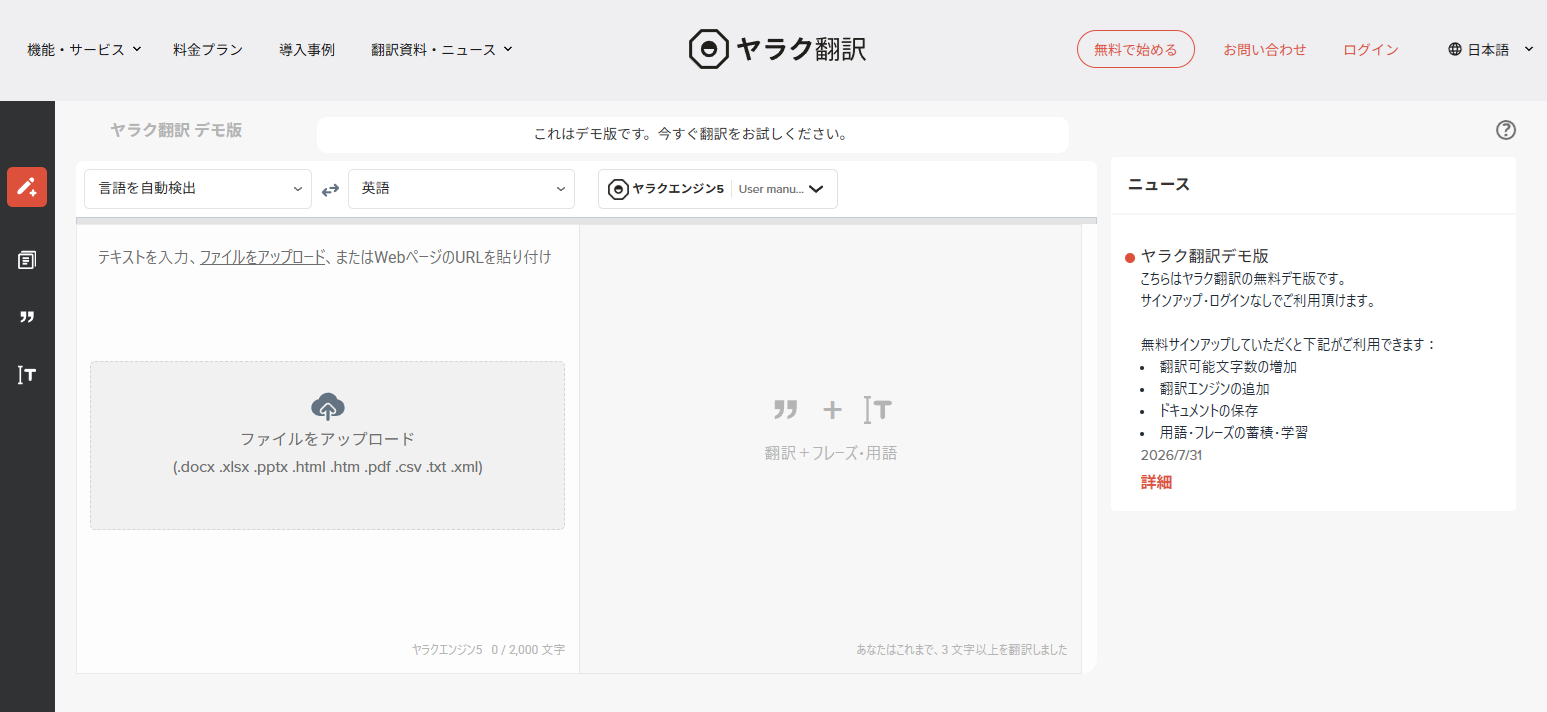
High-quality translation for text and files
Try the free Yaraku Translate demo with no sign-up required. Enter text or upload a file to get your translation. Give it a try.

Expert review: Masaru Yamada
He is a professor at Rikkyo University College/Graduate School of Intercultural Communication. After working as an in-house interpreter at Ford Motor Company and as an industrial translator, he founded Translation Lab Inc. He also serves as Chief Evangelist at Yaraku, Inc. (Full profile)
This article was localized from an expert-reviewed Japanese manuscript.
Conclusion
Free machine translation tools such as Google Translate and ChatGPT may use input data for training, so care is required when translating confidential information. To balance security and work efficiency, it is important to choose a translation tool with clearly defined security measures, such as data encryption and ISO 27001 certification.
Summary of this article
- Risks of data breaches in business translation and past case studies
- Comparison of the security of major machine translation tools, including Google Translate, Microsoft/Bing Translator and ChatGPT
- Methods for efficient translation while ensuring security, and key points for selecting tools.
What are the security risks of business translation?
Free translation tools are extremely convenient in business, but they can pose significant security risks. Particular care is needed when handling confidential information. Many free translation tools may reuse input data to improve their services, creating a risk that confidential information could be exposed externally.
There have been incidents in the past in which confidential information became publicly accessible after free translation tools were used.
Examples of data breaches
In 2015, a major information leak occurred involving the free translation tool “iloveTranslation”. Translation content entered by users was unintentionally made public. The leaked material included highly confidential business communications from government agencies and financial institutions, as well as privileged communications between lawyers and clients. The incident is described in detail in Nikkei CrossTech’s report “Information leakage via translation sites: banning their use alone will not solve the problem” [1].
The main factors behind this information leak were inadequate security settings on the translation site and insufficient privacy awareness among users. The site stated at the bottom that search results would be stored on the server to improve the translation service, and the checkbox at the beginning of the statement was selected by default. If users entered text without clearing the checkbox, the content was stored on the translation site and became accessible through search engines, making it viewable by anyone.
This case highlights the importance of information management in the digital age and the serious cybersecurity risks faced by companies and individuals. When using machine translation tools, it is important to remain aware of the risk of information leakage and take appropriate security measures.
Risks of data breaches and their impact on corporate image
An information leak can damage a company’s social credibility and cause it to lose the trust of customers and business partners. It may lead to customer attrition, suspension of business relationships and poorer business performance. If leaked information is misused by third parties, the damage may spread and result in substantial compensation claims.
According to a 2019 survey by the Japan Network Security Association (JNSA), the average estimated compensation per incident was ¥637.67 million. This figure is based on JNSA’s report, ‘2018 Information Security Incident Survey Results’ [2]. Investigating the cause of a leak and developing measures to prevent recurrence also require time and money.

The importance of security measures
Based on the points explained so far, it is important to recognise once again the importance of security measures in translation work. Handle confidential information in a trusted environment and always check the privacy policy of the translation tool you use.
Services provided by companies that have obtained a PrivacyMark or ISO 27001 certification meet advanced security standards.
In addition, choosing a paid corporate plan rather than a free tool can provide a more robust security environment.
Considering the security of major machine translation tools
In recent years, the performance of machine translation tools, including generative AI, has advanced. They are powerful tools that are extremely useful for global communication, but as the “iloveTranslation” incident shows, they need to be used carefully from a security perspective. We have summarised the security-related points described in the privacy policies of major machine translation tools.
Google Translate
Google’s privacy policy states that it collects information across Google services to provide better services to all users [3].
| We want you to understand the types of information we collect as you use our services We collect information to provide better services to all our users — from figuring out basic stuff like which language you speak, to more complex things like which ads you’ll find most useful, the people who matter most to you online, or which YouTube videos you might like. The information Google collects, and how that information is used, depends on how you use our services and how you manage your privacy controls. |
Source: Google Privacy Policy
By contrast, Google Cloud’s “Translation AI”, which can be regarded as a paid version of Google Translate, states that data is not used for translation training [4].
| ※ This is a translated excerpt. The original page is no longer available. Training no-code translation models with AutoML Access AutoML Translation features from Cloud Translation – Advanced and build custom models. All future model improvements are retained, and the models you build can continue to be used in the advanced tier services of Translation API and Translation Hub. Without coding, you can fine-tune Google’s pre-trained models using domain-specific datasets (pairs of source and target language segments) to improve accuracy. Your data is yours and will not be used to train Google models. |
Source: Text Translation (Advanced) | Cloud Translation
Microsoft/Bing Translator
Microsoft/Bing Translator has broadly similar conditions to Google. Microsoft states that data is not used for training when the paid Azure service is used, while data from the free version is recorded for service-improvement purposes [5].
| Azure Cognitive Services Translator is a cloud-based machine translation service and is part of the Azure Cognitive Services family of cognitive APIs for building intelligent apps. Customer data submitted for translation to Azure Cognitive Services Translator (both standard and custom models), Speech service, the Microsoft Translator Speech API, and the text translation features in Microsoft Office products are not written to persistent storage. There will be no record of the submitted text or voice, or any portion thereof, in any Microsoft data center. The audio and text will not be used for training purposes either.The free Microsoft Translator end-user products for which voice clips and text translations are recorded for service improvements purposes are listed below. Microsoft Translator apps Translator for Bing Microsoft Edge Web Translator |
Source: No Trace – Microsoft Translator for Business
ChatGPT
ChatGPT’s privacy policy also states that data is collected for personal use, but that this does not apply to business offerings [6]. In addition to the leakage of confidential information or personal data, the use of generative AI such as ChatGPT also involves the following risks.
• Incorrect information may be generated: because ChatGPT’s training data may not include the latest information, it may generate incorrect answers based on outdated information.
• Copyright-infringing content may be generated: if ChatGPT output contains content that infringes copyright, using it as-is may lead to legal issues.
| At OpenAI, our mission is to ensure that artificial general intelligence benefits everyone. We build tools like ChatGPT to help people learn, create, and solve problems. We at OpenAI (together with our affiliates, “OpenAI”, “we”, “our” or “us”) are committed to respecting your privacy and are strongly committed to keeping secure any information we obtain from you or about you. This Privacy Policy describes our practices with respect to personal data that we collect from or about you, and how we use it when you use our website, applications, and services (collectively, “Services”).This Privacy Policy does not apply to content that we process on behalf of customers of our business offerings, such as our API. Our use of that data is governed by our customer agreements covering access to and use of those offerings. |
Source: Privacy Policy | OpenAI
How to translate efficiently while ensuring security
As explained above, ensuring security is also an important challenge when using machine translation tools. Here, we explain how to balance security and efficiency in translation.
Prevent translation errors with AI + human review
AI translation tools are good at translating structured text such as business documents. Because they can accurately process standard expressions and specialist terminology, they can help reduce time and costs. However, complete accuracy is still not guaranteed. It is therefore important for people to check AI-generated translations and make corrections where necessary.
Human judgement is particularly important when expressions need to be selected according to context or cultural considerations. This hybrid approach enables high-quality, secure translation.
Configure and manage permissions for translation tools
Managing user access permissions is essential for maintaining security. Limit access to the translation tool to employees who need it for their work, and configure permissions in detail according to the confidentiality level of each document.
Other measures include single sign-on using SAML (Security Assertion Markup Language) authentication and IP address restrictions. Combining multiple measures can minimise the risks of unauthorised access and information leakage.
Choose a translation tool that balances security and work efficiency
Choosing the right translation tool is essential for balancing security and efficiency. Select a tool that provides data encryption, compliance with international security standards and customisable security settings. Dictionary features and API integration with existing systems are also important, as these can improve translation consistency and efficiency. A user-friendly interface that anyone can start using immediately is another key consideration. The right tool enables efficient translation work while maintaining security.
Meanwhile, there is also the practical view that “measures based on internal guidelines are sufficient”
Although we have explained the importance of security measures, many companies also take the realistic view that “if we strictly enforce internal rules, can’t we safely use corporate plans for ChatGPT or Gemini without introducing a paid tool dedicated to translation?”
“We should first establish an internal rule not to enter confidential information and start by improving employee literacy.” “Introducing a new tool solely for translation is costly. Wouldn’t an existing corporate generative AI plan be sufficient?”
For a company, it is a natural decision to first try to cover the risks of existing tools through internal operational rules without incurring additional costs.
So, in what situations should a company move beyond operational rules and consider a translation-specific tool with more advanced security features?
That point may come when the company begins to see the limits of a system that depends on each employee’s security awareness, or when it wants to manage the entire translation process organisationally and fundamentally reduce the risk of information leakage caused by human error.
Highly secure AI translation workspace “Yaraku Translate”
As business becomes increasingly global, demand for secure translation tools is growing. Yaraku Translate is attracting attention as an AI translation platform with advanced security features. Here are the features of Yaraku Translate that enable efficient translation while protecting confidential company information.
Data encryption and separate management
Yaraku Translate takes great care to protect data. All translation engines used by Yaraku Translate are individually contracted, so there is no concern that data will be reused for secondary purposes.
In addition, data is managed separately for each customer, so other users cannot access it. Confidential information such as passwords is encrypted in the database, providing a comprehensive security framework.
Reliability backed by ISO 27001 certification
Yaraku Translate is certified to ISO 27001, an internationally recognised information security standard.
This certification covers the full scope of planning, development and service provision for multilingual communication tools. ISO 27001 certification demonstrates that Yaraku Translate complies with strict information security standards.
Customisable security settings
To meet the different security needs of companies, Yaraku Translate offers flexible security options. These include single sign-on, IP address restrictions and stronger password settings. For organisations that require particularly advanced security, deployment in a private cloud is also available. This high degree of customisability is a major benefit for companies of various industries and sizes.
Is it okay to translate confidential information using a free machine translation tool?
Because free machine translation tools may use input data for training, care is required when translating confidential information. It is important to check the privacy policy and choose a tool whose data-handling practices are clear.
What are the key points to consider when choosing a safe translation tool?
Key points to check include data encryption, ISO 27001 certification and customisable security settings such as single sign-on and IP address restrictions. Choose a tool that can support efficient translation work while protecting confidential company information.
Can security risks be prevented simply by implementing translation tools?
No. In addition to introducing a tool, it is important to combine AI and human double-checking with appropriate permission settings and management for the translation tool. Establish an operating framework that balances security and work efficiency.
Secure and efficient translation work with “Yaraku Translate”
Yaraku Translate is an AI translation platform that combines advanced security with an efficient translation process. Data encryption, ISO 27001 certification and customisable security settings help protect confidential corporate information while supporting high-quality translation. Choose an appropriate translation tool to create a secure and efficient translation workflow.
References
[1] Nikkei CrossTech (March 2015). “Information leaks via translation sites: ‘Prohibition of use’ alone will not solve the problem.” Retrieved October 31, 2025,
https://xtech.nikkei.com/it/atcl/column/14/507007/030300004/
[2] Japan Network Security Association. “2018 Information Security Incident Survey Results – Personal Information Leaks Edition (Preliminary Report)”. Retrieved October 31, 2025.,
https://www.jnsa.org/result/incident/2018.html
[3] Google. “Google Privacy Policy”. Retrieved 31 October 2025,
https://policies.google.com/privacy
[4] Google Cloud. “Text Translation (Advanced) | Cloud Translation”. Retrieved 31 October 2025,
https://cloud.google.com/translate/docs/advanced/overview
[5] Microsoft. “No Trace – Microsoft Translator for Business”. Retrieved 31 October 2025,
https://www.microsoft.com/en-us/translator/business/notrace/
[6] OpenAI. “Privacy Policy”. Retrieved 31 October 2025,
https://openai.com/policies/privacy-policy/
High-quality translation for text and files
Try the free Yaraku Translate demo with no sign-up required. Enter text or upload a file to get your translation. Give it a try.
Expert review: Masaru Yamada
He is a professor at Rikkyo University College/Graduate School of Intercultural Communication. After working as an in-house interpreter at Ford Motor Company and as an industrial translator, he founded Translation Lab Inc. He also serves as Chief Evangelist at Yaraku, Inc. (Full profile)
This article was localized from an expert-reviewed Japanese manuscript.